






Back

Who we are

With research staff from more than 70 countries, and offices across the globe, IFPRI provides research-based policy solutions to sustainably reduce poverty and end hunger and malnutrition in developing countries.

Danielle Resnick

Danielle Resnick is a Senior Research Fellow in the Markets, Trade, and Institutions Unit and a Non-Resident Fellow in the Global Economy and Development Program at the Brookings Institution. Her research focuses on the political economy of agricultural policy and food systems, governance, and democratization, drawing on extensive fieldwork and policy engagement across Africa and South Asia.

Back

What we do

Since 1975, IFPRI’s research has been informing policies and development programs to improve food security, nutrition, and livelihoods around the world.

Where we work

Back

Where we work

IFPRI currently has more than 480 employees working in over 70 countries with a wide range of local, national, and international partners.

IFPRI Strategy

2026-2030

FOOD POLICY RESEARCH for a CHANGING WORLD

Blogs


News


Events


Publications

Journal Article

A food system transformation pathway reconciles 1.5 °C global warming with improved health, environment and social inclusion

2025
Bodirsky, Benjamin Leon; Beier, Felicitas; Humpenöder, Florian; Leip, Debbora; Crawford, Michael S.; Chen, David Meng-Chuen; von Jeetze, Patrick; Springmann, Marco; Soergel, Bjoern; Nicholls, Zebedee
…more Strefler, Jessica; Lewis, Jared; Heinke, Jens; Müller, Christoph; Karstens, Kristine; Weindl, Isabelle; Stevanović, Miodrag; Rein, Patrick; Sauer, Pascal; Mishra, Abhijeet; Bacca, Edna Johanna Molina; Köberle, Alexandre C.; Wang, Xiaoxi; Singh, Vartika; Hunecke, Claudia; Collignon, Quitterie; Schreinemachers, Pepijn; Dietz, Simon; Kanbur, Ravi; Dietrich, Jan Philipp; Lotze-Campen, Hermann; Popp, Alexander

A food system transformation pathway reconciles 1.5 °C global warming with improved health, environment and social inclusion

The improvement of the global food system requires a thorough understanding of how specific measures may contribute to the system’s transformation. Here we apply a global food and land system modelling framework to quantify the impact of 23 food system measures on 15 outcome indicators related to public health, the environment, social inclusion and the economy, up to 2050. While all individual measures come with trade-offs, their combination can reduce trade-offs and enhance co-benefits. We estimate that combining all food system measures may reduce yearly mortality by 182 million life years and almost halves nitrogen surplus while offsetting negative effects of environmental protection measures on absolute poverty. Through joint efforts, including measures outside the food system, the 1.5 °C climate target can be achieved.

Year published

2025

Authors

Bodirsky, Benjamin Leon; Beier, Felicitas; Humpenöder, Florian; Leip, Debbora; Crawford, Michael S.; Chen, David Meng-Chuen; von Jeetze, Patrick; Springmann, Marco; Soergel, Bjoern; Nicholls, Zebedee; Strefler, Jessica; Lewis, Jared; Heinke, Jens; Müller, Christoph; Karstens, Kristine; Weindl, Isabelle; Stevanović, Miodrag; Rein, Patrick; Sauer, Pascal; Mishra, Abhijeet; Bacca, Edna Johanna Molina; Köberle, Alexandre C.; Wang, Xiaoxi; Singh, Vartika; Hunecke, Claudia; Collignon, Quitterie; Schreinemachers, Pepijn; Dietz, Simon; Kanbur, Ravi; Dietrich, Jan Philipp; Lotze-Campen, Hermann; Popp, Alexander

Citation

Bodirsky, Benjamin Leon; Beier, Felicitas; Humpenöder, Florian; Leip, Debbora; Crawford, Michael S.; et al. 2025. A food system transformation pathway reconciles 1.5 °C global warming with improved health, environment and social inclusion. Nature Food 6(12): 1133-1152. https://doi.org/10.1038/s43016-025-01268-y

Keywords

Capacity Building; Food Systems; Health; Environment; Social Inclusion; Climate Change; Global Warming

Language

English

Access/Licence

Open AccessCC-BY-4.0

Record type

Journal Article

Journal Article

Armed conflict and climate-induced weather disruptions in agricultural input use: Evidence From Ethiopia

2026Ayalew, Hailemariam; Berhane, Guush; Wondale, Meserete; Breisinger, Clemens

Armed conflict and climate-induced weather disruptions in agricultural input use: Evidence From Ethiopia

Year published

2026

Authors

Ayalew, Hailemariam; Berhane, Guush; Wondale, Meserete; Breisinger, Clemens

Citation

Ayalew, Hailemariam; Berhane, Guush; Wondale, Meserete; and Breisinger, Clemens. 2026. Armed Conflict and Climate-Induced Weather Disruptions in Agricultural Input Use: Evidence From Ethiopia. Agricultural Economics 57(1): e70083. https://doi.org/10.1111/agec.70083

Country/Region

Ethiopia

Keywords

Eastern Africa; Sub-saharan Africa; Africa; Conflicts; Farm Inputs; Weather Hazards; Armed Conflicts; Climate Change

Language

English

Access/Licence

Limited Access

Project

National Policies and Strategies

Record type

Journal Article

Journal Article

Associations between Global Diet Quality Score (GDQS) and obesity in women of reproductive age in Northern Tanzania: A cross-sectional study

2026Bliznashka, Lilia; Azupogo, Fusta; Reynolds, Elise; Arnold, Charles D.; Hess, Sonja Y.; Kinabo, Joyce; Jeremiah, Kidola; Malindisa, Evangelista; Olney, Deanna K.; Ruel, Marie T.

Associations between Global Diet Quality Score (GDQS) and obesity in women of reproductive age in Northern Tanzania: A cross-sectional study

Background Obesity is an increasing problem among women of reproductive age (WRA) in Tanzania. Objective We described WRA’s nutritional status by socio-demographic factors and assessed associations with diet quality. Methods We analysed baseline data from a cluster-randomised controlled trial in Arusha and Kilimanjaro regions (n=2,415). Diet was assessed using a quantitative 24-hour recall. We calculated the Global Diet Quality Score (GDQS; 0-49), with higher scores indicating healthier diet. General obesity was defined as body mass index (BMI)≥30 kg/m2; morbid obesity as BMI≥35 kg/m2; and central obesity as: waist circumference (WC)≥80 cm, WC≥88 cm, waist-to-hip ratio (WHR)≥0.85, waist-to-height ratio (WHtR)≥0.50, and WHR≥0.85 or BMI≥30 kg/m2. We tested associations between diet quality and nutritional status using generalised linear models controlling for age and sociodemographic factors and tested interactions to assess differential associations by age groups. Results The prevalence of general obesity was 25.1%, morbid obesity 8.4%, and central obesity 48.2-71.6% depending on the definition. Mean GDQS was 20.9±3.9. General and central obesity were more prevalent among women who were older, less educated, had light physical labour occupations, were in the highest wealth quintile, and lived in more urbanised villages and in more food secure households. Higher GDQS was associated with lower risk of morbid obesity: risk ratio (RR) 0.97 (95% CI 0.94, 1.00). Higher GDQS was also associated with 0.25-0.27 kg/m2 lower BMI, 0.54-0.66 cm lower WC, and 0.53-0.58 cm lower hip circumference in women 30-49 years of age. Conclusion Better diet quality emerged as a protective factor for morbid obesity and for other obesity measures among women 30-49 years of age. Our study suggests that interventions to improve diet quality in Tanzania should target women in their thirties and forties and those with lower physical activity and higher education, food security, and wealth to maximise effectiveness.

Year published

2026

Authors

Bliznashka, Lilia; Azupogo, Fusta; Reynolds, Elise; Arnold, Charles D.; Hess, Sonja Y.; Kinabo, Joyce; Jeremiah, Kidola; Malindisa, Evangelista; Olney, Deanna K.; Ruel, Marie T.

Citation

Bliznashka, Lilia; Azupogo, Fusta; Reynolds, Elise; Arnold, Charles D.; Hess, Sonja Y.; et al. 2026. Associations between Global Diet Quality Score (GDQS) and obesity in women of reproductive age in Northern Tanzania: A cross-sectional study. Journal of Nutrition 156(2): 101282. https://doi.org/10.1016/j.tjnut.2025.101282

Keywords

Tanzania; Africa; Sub-saharan Africa; Eastern Africa; Health; Diet Quality; Obesity; Gender; Women; Healthy Diets; Nutrition

Language

English

Access/Licence

Open AccessCC-BY-4.0

Record type

Journal Article

AI image of robot sitting at computer screen showing charts over images of agricultural fields

What Do We Know About the Future of Food Systems?

IFPRI Book published in July 2025

This book, What Do We Know About the Future of Food Systems?, is a collection of short chapters that synthesize current knowledge about different aspects of the future of food systems. Written by more than 100 scientists from around the world with expertise in a wide range of related disciplines and regions, these chapters provide accessible overviews of the latest foresight research on each topic, guide readers toward more detailed information, and offer insights into how our knowledge of future trends can be improved.

Experts in Our Field

IFPRI’s experts work around the world to provide the evidence that supports effective policies to sustainably reduce poverty and end hunger and malnutrition.

480+

staff across the world

70+

countries where we work

#1

in the field of Agricultural Economics

25,000+

research outputs

Meet a Researcher

Sediqa Zaki is a Research Analyst in the Markets, Trade, and Institutions Unit. Her research interests center on poverty alleviation, international trade and food price monitoring, gender-responsive policymaking, and public sector analysis. Before joining IFPRI, Sediqa worked in Afghanistan with the United Nations World Food Program (WFP), the Ministry of Economy, and the Ministry of Finance. Sediqa has a master’s degree in development practice from the University of California, Berkeley, and a master’s degree in economics from the University of…

Sediqa  Zaki

From our video channel

In this video, Mamata Pradhan, Research Coordinator in the Development Strategies and Governance Unit, discusses her diverse research topics, including scaling up climate-smart agriculture in South Asia, agrifood trade, and agricultural transformation, as well as her advice for the next generation of researchers. 

“Faces of IFPRI” is a series of interviews with IFPRI colleagues around the world, showcasing the diversity of talent, geographies, and research interests across the Institute. 

Making a Difference Blog Series
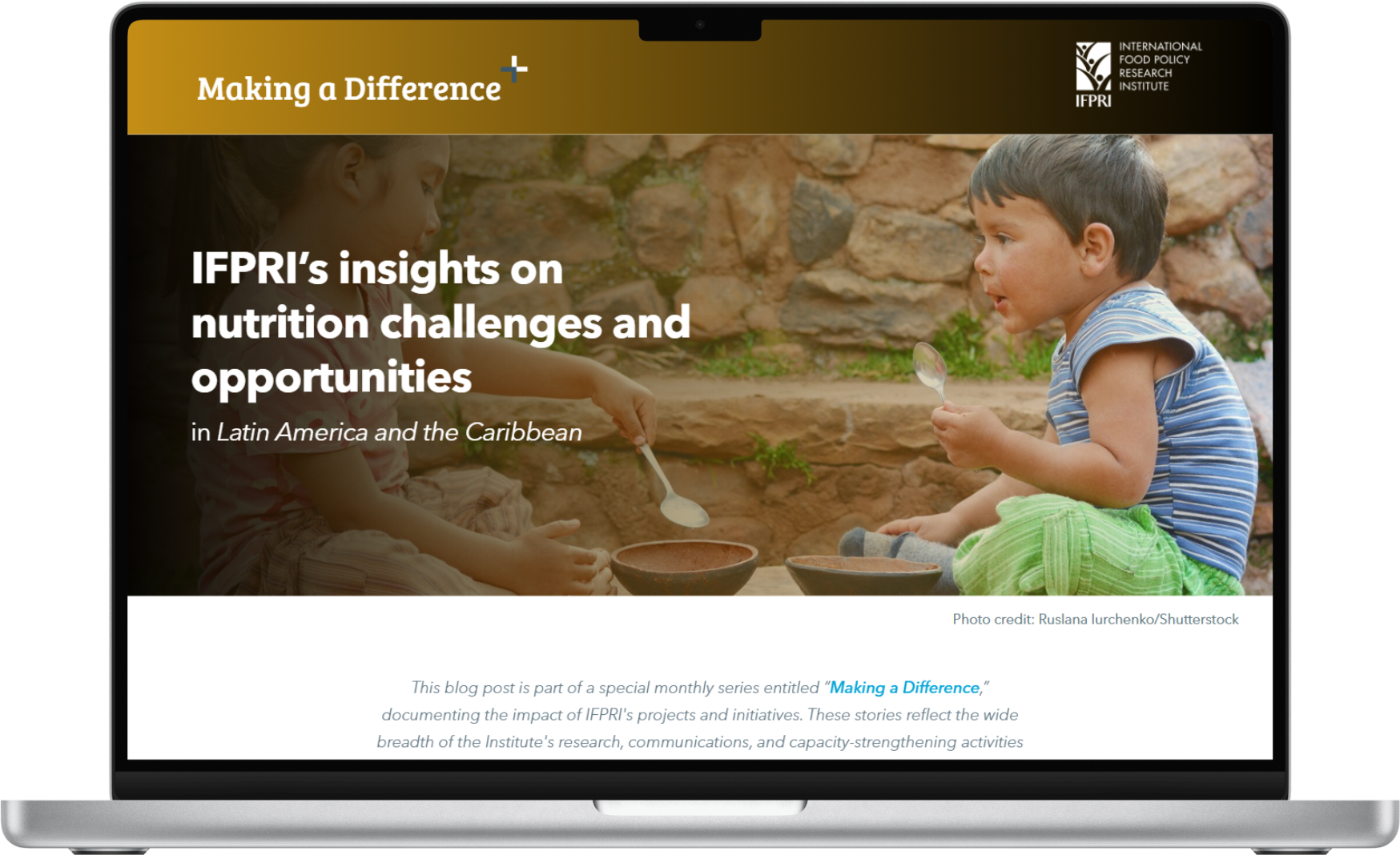
In 2014, IFPRI and the Gates Foundation launched the AReNA project to bridge agriculture and nutrition research, addressing data gaps and advancing understanding of how agriculture can better improve diets and nutrition worldwide.

The AReNA project created a one-of-a-kind dataset that links nutrition-related indicators to agricultural and environmental indicators. The dataset has been used for countless studies on the determinants of child stunting, wasting, and feeding practices.

AReNA was the first project to use the World Bank’s International Comparison Program (ICP) data on retail food prices—covering 175 countries and 800 food items—to study the affordability of healthy and unhealthy diets. It significantly influenced the adoption of healthy diet metrics in FAO-led State of Food Security and Nutrition reports and led to the widely-cited finding—used by the FAO, World Bank, and others—that 3 billion people cannot afford a healthy diet.